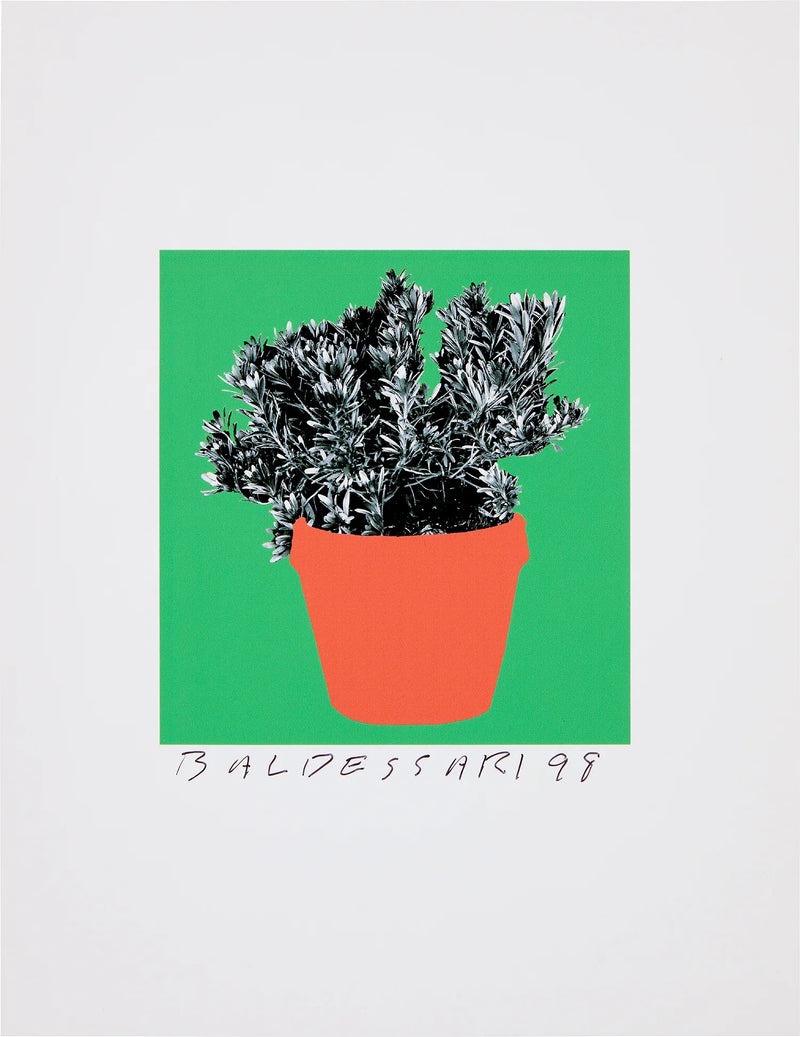
John Baldessari's studio practice represented a radical departure from traditional artistic production, emphasizing conceptual decision-making over technical execution while pioneering collaborative and appropriation-based methodologies. Working from his studios in Santa Monica and later Venice, California, Baldessari developed a practice characterized by intellectual play, strategic delegation, and the transformation of existing visual material.
Central to Baldessari's approach was his handling of physical materials. Rather than creating images from scratch, he primarily worked with found photographs, film stills, and other pre-existing visual elements, selecting and combining them to create new meanings. This appropriation-based methodology, beginning with his early photo-text pieces of the late 1960s, established a conceptual framework where the artist functions as editor and arranger rather than conventional creator. For many significant works, Baldessari employed professional photographers, sign painters, and printers to execute components according to his specifications, challenging traditional notions of artistic authorship and craftsmanship.
Baldessari's technical innovations included his iconic application of colored dots to obscure faces in photographs, a strategy he began in the early 1980s. These interventions, precisely applied by studio assistants following his direction, became a signature visual element that simultaneously anonymized the subjects and transformed documentary images into formal compositions. Similarly, his strategic cropping, enlargement, and juxtaposition of photographic elements created new syntactical relationships between seemingly unrelated images, revealing unexpected connections and cultural codes.
What distinguishes Baldessari's production method was its combination of conceptual rigor and intuitive decision-making. While intellectually grounded in linguistic theory and semiotics, his selection and arrangement of images often followed what he called "gut instinct," creating works that function simultaneously as theoretical propositions and visually compelling compositions. His studio functioned as a laboratory for testing these combinations, with works often evolving through multiple iterations before reaching their final form.
In later decades, Baldessari expanded his operation to include a team of assistants who helped manage his increasingly complex production needs, particularly for museum installations and large-scale commissions. This collaborative approach allowed him to maintain remarkable productivity into his 80s while ensuring conceptual consistency across varied projects. Throughout these evolutions, Baldessari maintained his commitment to idea-driven work that questioned visual conventions while engaging viewers through accessible humor and striking formal arrangements.