James Turrell
b. 1943, Los Angeles, California · Lives and works in Flagstaff, Arizona · 1 work available
The editions
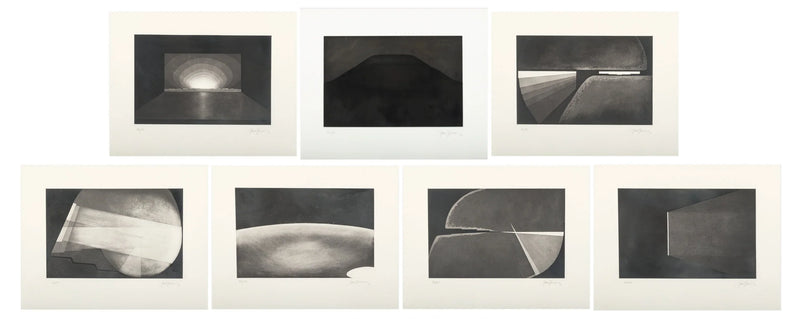
James Turrell's approach to creating art is unique in its integration of scientific understanding, technological innovation, and spiritual exploration. Working with a team of engineers, architects, and fabricators, Turrell develops his installations through rigorous planning and precise execution. His studio practice begins with detailed drawings, architectural plans, and scale models that map the interaction of light, space, and human perception, often requiring mathematical calculations to achieve specific perceptual effects.
Turrell's installations fall into several distinct categories, each representing different aspects of his exploration of light. His "Skyspaces"—architectural chambers with apertures open to the sky—create controlled viewing experiences of celestial light that change with atmospheric conditions. "Ganzfelds" produce immersive fields of homogeneous color that eliminate depth perception, creating what Turrell calls "behind-the-eyes seeing." His "Wedgeworks" and "Shallow Space Constructions" use projected light to create the illusion of walls or barriers, while his "Dark Spaces" require extended viewing in near-total darkness as the viewer's eyes adapt to reveal subtle light phenomena.
What distinguishes Turrell's practice is his treatment of light not as an illumination source for other objects but as the object itself. Using both natural and artificial light, he creates experiences that reveal the subjective nature of perception. His installations typically require long viewing periods—sometimes up to an hour—allowing viewers to experience how their perception changes over time. Each work is meticulously calibrated to create specific perceptual effects, with Turrell often spending years perfecting a single installation. This dedication to the phenomenology of perception places Turrell in a unique position within contemporary art, bridging experiential art, architectural intervention, and perceptual psychology.
Biography
James Turrell's contribution to contemporary art is characterized by his revolutionary approach to light as a medium in itself rather than merely an illumination source. By creating works that engage directly with human perception, he has expanded the boundaries of what art can be and how it can be experienced. His integration of scientific understanding of perceptual psychology with aesthetic and spiritual concerns has influenced generations of artists working with light, space, and immersive experiences.
His Skyspaces have created a new architectural typology that focuses on the framing and perception of natural light, while his collaborations with architects like Tadao Ando have demonstrated the potential for integrating art and architecture.
The ongoing Roden Crater project represents perhaps his most significant contribution—a monumental work that connects contemporary art with ancient traditions of celestial observation. This ambitious project, which has been under construction for over 40 years, embodies Turrell's lifelong commitment to creating experiences that transform perception and connect viewers with cosmic phenomena. As it nears completion with support from major institutions and patrons, Roden Crater stands to become one of the most significant artistic achievements of our time—a work that bridges art, science, and spirituality while offering experiences available nowhere else.
Available works
Looking for other works by James Turrell?
Tell us what you're seeking and we'll source it privately — documented before it reaches you. Selling one? We hold collector interest across the editions.